some important terminologies with related soil water.
- Saturation capacity – Soil is at its maximum retain capacity.
- Field capacity – A measure of the maximum amount of the water that soil can hold.
- Permanent wilting point – The minimum soil moisture at which a plant wilt and no longer recover its turgidity.
- Available water content (AWC) – The amount water between Field capacity and permanent wilting point.
- Hygroscopic water – water that remaining adhere to the soil particles and unavailable for the plants.
- Capillary water – The excess of the hygroscopic water that can be absorbed by the plants.
- Gravitational water – The excess of hygroscopic and capillary water which will move out from the soil.
Saturation capacity Vs Field capacity
Saturation capacity the maximum amount of water that soil can absorb when all the pores in soil are filled with water.
Field capacity is the amount of water that can hold by the soil, when after the soil become saturated and excess water is drain away by gravitational force
Testing water before using for agriculture
- TDS – total dissolve solid (<1400ppm)
- Excess mineral tests (high Na content is toxic, Br, Li)
- Toxic waste
- Biological contaminants (plant pathogens)
Irrigation
Process of supplying water to the soil with adequate amount for optimum plant growth.
Objective of the irrigation
- To supply the essential moisture for the plants which important for transport of essential nutrients. and dilute the salts in the soil.
- Make favorable environment to plants growth by cooling the soil and atmosphere.
Types of irrigations
- Surface irrigation
- Sprinkler irrigation
- Subsurface irrigation
- Trickle irrigation
Surface irrigation
water is distributed over the field by a free-surface by gravity, soil were typically high in clay and silt content relatively small pores to reduce the water loss. flow is introduced at a high point.
Advantages of surface irrigation
- Less power needed
- minimum capital cost
Disadvantages of surface irrigation
- Less efficient than sprinkle and trickle methods
- Waterlogging and salinity problems
- insufficient distributed because for more water is supplied closest to the source.
- soil erosion
Types of surface irrigation
- Basin irrigation
- Border irrigation
- Furrow irrigation
Basin irrigation
The most common form of surface irrigation.
The field is divided into several small basins, basins are separated by low ridges or bunds prevent the water from flowing from one basin to another. Each basins contains more rows, flooded with water.
Border irrigation
The field is divided narrow long borders each border has many rows, broders are separated by low ridges, flooded with water.
Furrow irrigation
The field is divided into long, narrow furrows, created between the rows of crops. Water is then applied to the furrows. These are get flooded.
Sprinkler irrigation
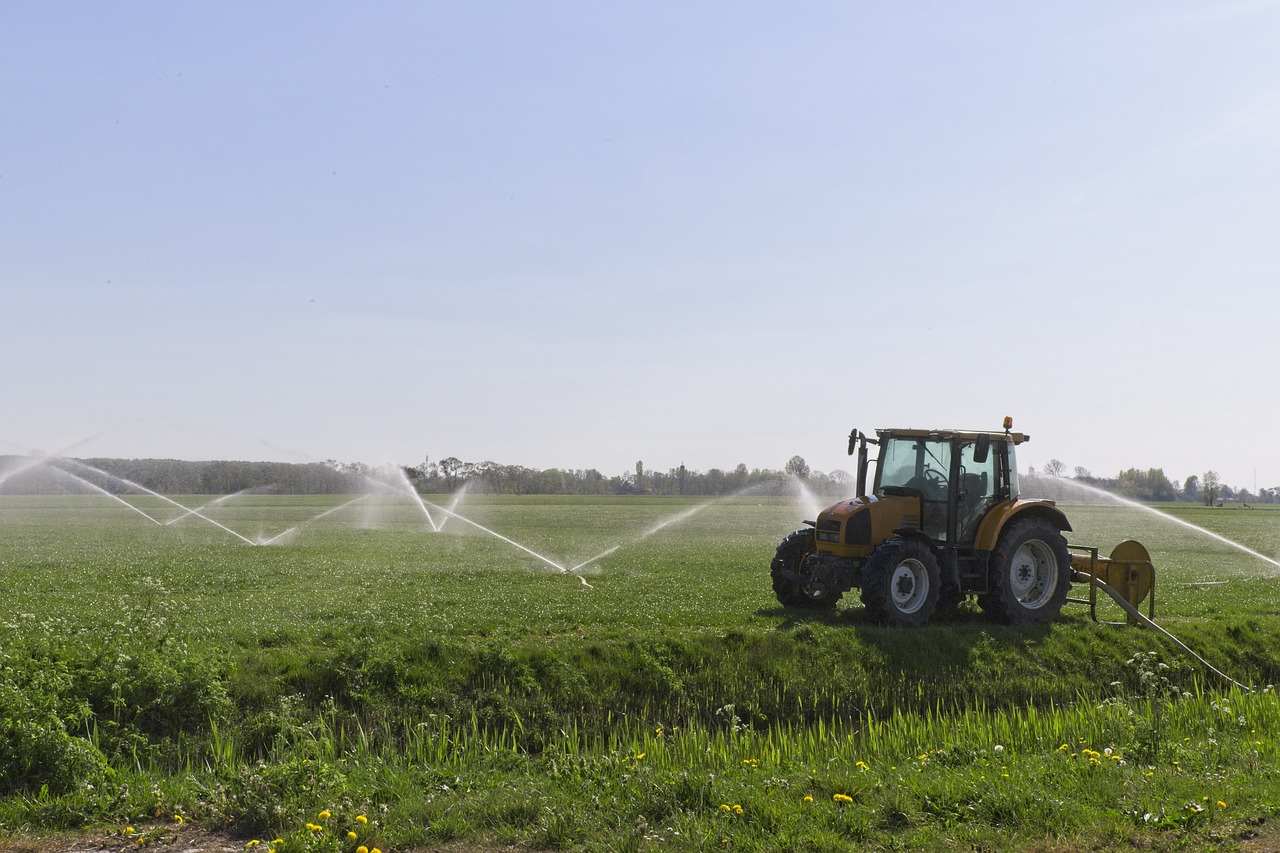
Water is delivered as a spray or sprinkler pattern, simulating natural rainfall.
Advantages of sprinkler methods
- Uniform distribution of water.
- Water can be sprayed over and under the canopy
- No soil erosion or waterlogging
- High water used efficiency plant production per unit
- Provide cooler water than surface method.
Disadvantages of sprinkler methods
- High initial cost
- High power requirements.
- High evaporation of water loss
- Wind can be interfere with the uniform distribution of water.
Subsurface irrigation
Irrigation water is applied below the soil surface. ground must be level and subsurface soil must be permeable enough to permit the rapid movement of water laterally and vertically. A bottom barrier(clay soil layer or rock) to prevent the water leaching.
Trickle irrigation
Plant won’t become water stressed. water is applied frequently but in very slowly in small amounts and extremely versatile method.
Water is delivered through a network of pipes that are placed near the root zone of the crops.
This system can be automated for the watering and also fertilizing the crop plants.
Problems of trickle methods
- blockages of the pipelines due to bacterial slime
- high capital cost and maintaining
References
- Surface irrigation – Wikipedia. (2015, August 13). Surface Irrigation – Wikipedia. https://en.wikipedia.org/wiki/Surface_irrigation#/media/File:LevelBasinFloodIrrigation.JPG
- M. (2001, March 1). Irrigation methods. Irrigation Methods. https://www.slideshare.net/madhujegathish/irrigation-methods-47460450
- What is Furrow Irrigation? Suitability, Planning, Steps – Civil Engineering. (n.d.). What Is Furrow Irrigation? Suitability, Planning, Steps – Civil Engineering. https://civiltoday.com/water-resource-engineering/irrigation/282-furrow-irrigation
- What is drip irrigation? (n.d.). Quora. https://www.quora.com/What-is-drip-irrigation
- A. (2018, August 7). Type Of Soil Water detail : agri learner. Agri Learner. https://www.agrilearner.com/type-of-soil-water/